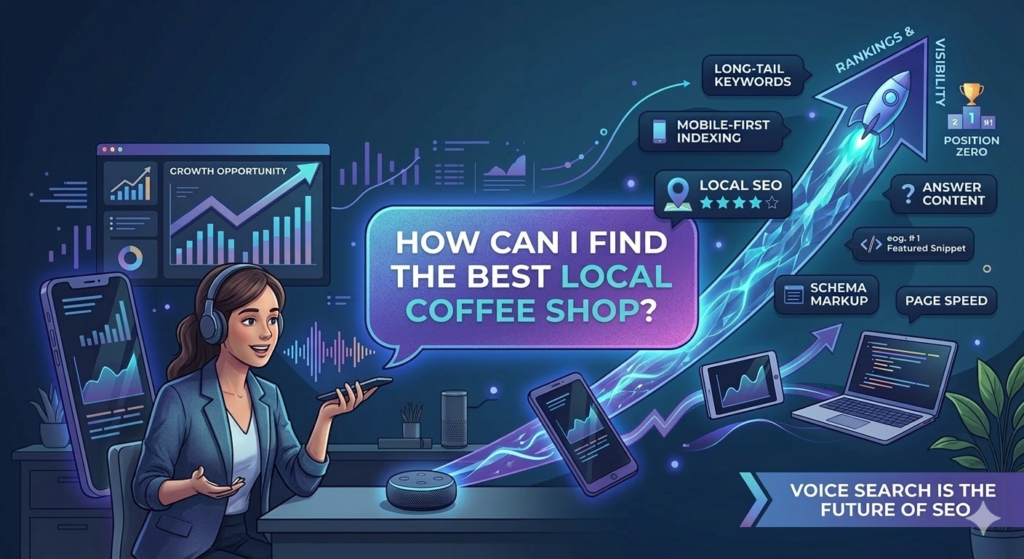
Digital Marketing Strategists are always looking for new ways to improve search visibility and reach the right audience online. One of the fastest growing trends today is voice search optimization. As more people use voice assistants to search for information, businesses need to adapt their SEO strategies to stay visible in voice search results.
How smart brands are getting ahead of the conversational search revolution“Imagine a person on their way to work asking their phone, ‘Hey Siri, find a coffee shop near me that’s open now.’
Within seconds, the device suggests a nearby option. Within seconds, a business can win a new customer while another loses the opportunity. This shows how voice search is playing a bigger role in the way people search for products and services today. It’s no longer futuristic it’s happening right now.. It’s happening billions of times a day across smartphones, smart speakers, cars, and TVs
However, many businesses still create and optimize their content as if users only search by typing on a desktop. This difference between how people actually search and how businesses plan their SEO strategies has become one of the biggest untapped opportunities in digital marketing today.
If you want to secure your digital future, voice search optimization has become essential.
Voice Search Adoption: Important Stats
Voice search adoption is expanding fast across the world:
- Over 50% of all smartphone users now use voice search at least once a day.
- More than 1 billion voice searches occur every single month globally.
- The number of smart speakers in homes worldwide has reached hundreds of millions.
- Voice commerce purchasing via voice command is projected to become a multi-billion-dollar industry within the next few years.
What’s driving this? Convenience, speed, and the growing sophistication of natural language processing (NLP). As AI-powered assistants like Google Assistant, Amazon Alexa, Apple Siri, and Microsoft Cortana get smarter, people trust them more and use them more.
Why Voice Search Is Fundamentally Different from Text Search

Here’s where most SEO professionals miss the mark: they treat voice search as just another keyword variation. It isn’t. Because voice search works differently from traditional search, it requires a unique optimization strategy.
Conversational, Long-Tail Queries
When people type a search, they often use short phrases like “best Italian restaurant NYC.” But with voice search, users tend to ask full questions such as “What’s the best Italian restaurant near me open for dinner tonight?” These voice queries are longer and more conversational, which means businesses can benefit by optimizing for long-tail, natural phrases where competition is usually lower than traditional typed keywords.
Question-Base Search Intent
Voice searches are dominated by question words: Who, What, Where, When, Why, and How. If your content clearly answers common questions in your field, it has a strong chance of appearing in the featured snippet the top search result that voice assistants often use to deliver spoken answers.
Local and Immediate Intent
A massive proportion of voice searches are local: “near me,” “open now,” “closest.” According to Google, “near me” mobile searches have grown by over 500% in recent years. For local businesses, this is a direct line to high-intent customers who are ready to act immediately.
The Featured Snippet: Voice Search's Holy Grail
If traditional SEO is a race to “Page 1,” voice search SEO is a race to Position Zero the featured snippet that appears above all other results. When a user asks a voice assistant a question, it overwhelmingly reads from the featured snippet. This means voice search is often a winner-take-all game.
Winning featured snippets requires a deliberate content strategy:
- Structure content with clear questions as headers (H2 or H3) followed by concise, direct 40-60 word answers.
- Use bulleted or numbered lists to explain processes Google loves pulling these into snippet format.
- Create dedicated FAQ sections on key pages, targeting the exact questions your audience is asking.
- Ensure your answer is authoritative, accurate, and built on content Google already trusts.
Practical Voice Search Optimization Strategies
So how do you actually optimize for voice search? Start with these impactful strategies today:
- Build a Robust FAQ Strategy
Think about every question your customers ask — before they buy, during their research, after a purchase. Then create content that answers those questions clearly and directly. Tools like AnswerThePublic, AlsoAsked, and Google’s “People Also Ask” section are treasure troves for identifying real voice-search-style queries.
- Optimize for Local Voice Search
Local voice search is one of the highest-converting traffic sources in existence. To capture it:
- Claim and fully optimize your Google Business Profile with accurate hours, address, phone number, and photos.
- Ensure your NAP (Name, Address, Phone) data is consistent across all online directories.
- Build location-specific landing pages that naturally incorporate phrases like “in [city]” and “near [neighborhood].”
- Implement Structured Data (Schema Markup)
Schema markup is code added to your website that helps search engines understand your content’s context. For voice search, FAQ Page schema, How To schema, and Local Business schema are especially powerful they dramatically increase the chances that your content is selected as the answer read aloud by a voice assistant.
- Prioritize Mobile Speed and Core Web Vitals
The majority of voice searches happen on mobile devices. If your site loads slowly or delivers a clunky mobile experience, Google will not consider it a reliable source for voice answers — regardless of your content quality. Aim for page load times under 3 seconds, use responsive design, and pass Google’s Core Web Vitals benchmarks.
- Write in Natural, Conversational Language
Writing in a natural, conversational style helps content perform better in voice search. If your content is packed with keyword-stuffed phrases written for algorithms rather than humans, it won’t perform well in voice. Aim for an 8th-grade
reading level, use contractions, and write as if you’re explaining something to a friend — not drafting a corporate press release.
The Early Advantage in Voice Search Is Still Available
Here’s the uncomfortable truth: most of your competitors are not doing this yet. Voice search optimization remains an underutilized strategy in most industries, which means there is a very real first-mover advantage available right now. The brands and businesses that build voice-optimized content ecosystems today will establish authority positions that become increasingly difficult to dislodge as voice search continues to grow.
We’ve seen this pattern before. Early movers in mobile optimization, local SEO, and content marketing all reaped disproportionate rewards — while late adopters scrambled to catch up in a much more crowded and expensive environment. Voice search is currently at that same inflection point
This Means What for Your SEO Strategy Going Forward
Voice search optimization isn’t about abandoning your existing SEO strategy — it’s about evolving it. The foundations remain the same: technical excellence, authoritative content, and strong backlinks. What changes is how you structure and write that content, how you handle local signals, and how aggressively you pursue featured snippets.
Think of voice search as the next layer of your SEO strategy — one built on top of everything you already know, but calibrated for the way people actually talk.
Start by auditing your most important pages through the lens of voice search:
- Do they answer questions directly and concisely?
- Are they optimized for local intent where relevant?
- Do they use structured data markup?
• Do they load fast on mobile and deliver a seamless experience?
Final Thoughts
Voice search is not a trend to watch from the sidelines. It is the natural evolution of how humans interact with technology and it is already reshaping the SEO landscape in profound ways. The businesses that recognize this now and invest in conversational, question-driven, locally-aware content will own some of the most valuable digital real estate of the next decade.
The question isn’t whether voice search will become dominant. It already is. The question is whether you’ll be found when it matters most or whether your competitor will answer that question instead.
The microphone is open. It’s time to make sure your brand is the one speaking.